Loading... Today

-- 0

-- 0
The Print Times
Global Primary Energy
Global Primary Energy Supply 20254 The global energy sector continued to witness steady expansion in CY 2025, supported by economic activity, rising electricity consumption and continuing electrification across end-use sectors. As per the IEA Global Energy Review 2026, global primary energy supply increased by 1.3% to 655 Exajoule (EJ) in 2025 from 646 EJ in 2024. However, the growth rate moderated compared to the previous year due to sustained geopolitical uncertainties, slower economic growth momentum and overall efficiency improvements across consuming sectors.
Fuel-wise, all major energy sources registered growth, albeit at varying rates. Renewables recorded the fastest growth, while fossil fuels continued to retain a significant share in the global energy basket, underlining the dual challenge of ensuring energy security while advancing decarbonisation objectives.
Amongst fossil fuels, Natural gas demand growth moderated sharply to around 1.0% in 2025, compared with 2.8% in 2024, amid relatively elevated prices during the first half of the year. Incremental demand was led by the United States, European Union and the Middle East, while Asia Pacific recorded comparatively weaker growth.
An important efficiency indicator that improved during the year, was the global energy intensity (energy use per unit of GDP, which improved by nearly 2% in 2025. While the global energy intensity trend during 2019-2024 was around 1.3% annually. This reflected stronger renewable penetration, efficiency gains and more moderate weatherdriven demand growth.
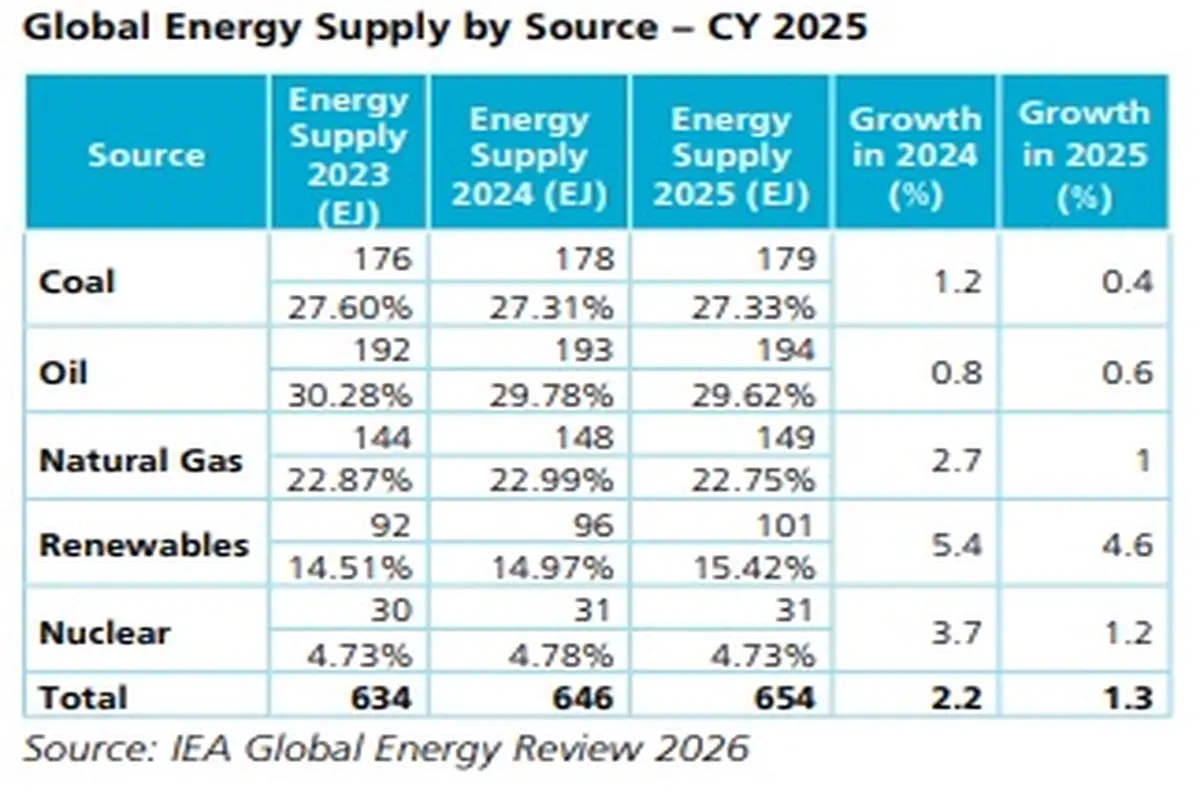
Low-emission energy sources continued to drive global energy growth in CY 2025, with solar PV accounting for over 25% of incremental demand, followed by natural gas at 17%. Collectively, renewables and nuclear contributed nearly 60% of global energy demand growth, reflecting the ongoing energy transition. Global electricity demand grew by around 2.8% to 32,132 TWh—more than twice the rate of overall energy demand growth—driven by industry, buildings, electric mobility, cooling needs and digital infrastructure, reinforcing the emergence of the "Age of Electricity."
Global Gas Sector
Demand and Supply Trends
Global natural gas demand registered moderate growth during CY 2025. Demand growth was driven by the power, industrial and city gas sectors, while natural gas continued to play a critical role in balancing intermittent renewable generation and supporting energy transition objectives.
On the supply side, global gas production remained volatile, which however was supported by increased output from the United States, Qatar and other major producing regions. Several LNG projects progressed during the year, including the expansion of Qatar's North Field East and North Field South projects, the Plaquemines LNG project and Corpus Christi Stage III in the United States and LNG Canada Phase-I. These projects are expected to contribute significantly to global LNG supply over the coming years.
Europe remained dependent on LNG imports to replace reduced Russian pipeline gas supplies. While gas storage levels were generally comfortable entering winter, colder weather conditions and periodic supply concerns led to increased procurement of LNG cargoes. In North America, severe winter storms during early 2025 temporarily disrupted gas production and LNG export operations, contributing to short-term market volatility.
LNG Market and Price Trends
Global LNG markets remained relatively balanced for most of CY 2025, supported by new LNG supply additions and moderate demand growth.
Asian spot LNG prices (JKM) averaged around US$12.15/ MMBtu during CY 2025, while European gas prices (TTF) averaged around US$12.11/MMBtu. Prices remained significantly below the peaks witnessed during the energy crisis of 2022 but continued to exhibit periodic volatility. During early 2026, escalating geopolitical tensions in the Middle East and concerns regarding LNG supply security led to a sharp increase in both JKM and TTF benchmarks. Henry Hub prices in the United States remained comparatively lower, reflecting robust domestic production growth and continued expansion of export capacity.
The widening price differential between Henry Hublinked LNG contracts and spot LNG prices reinforced the importance of long-term LNG contracts, portfolio diversification and destination flexibility for LNG importers.
Indian Energy Sector
India’s energy sector in FY 2025-26 navigated a transformative year, characterized by robust economic momentum, aggressive pursuit of decarbonization goals and a critical structural shock triggered by the Hormuz geopolitical crisis.
Total Energy Supply (TES) for India increased to 39.10 EJ in CY 2025 from 38.82 EJ in CY 2024, registering a growth of ~0.72%, while India’s overall energy import dependency remained elevated at approximately 87% for crude oil5 , 54.35% for natural gas6 and 21.88% for coal7 , underscoring structural reliance on external energy sources.
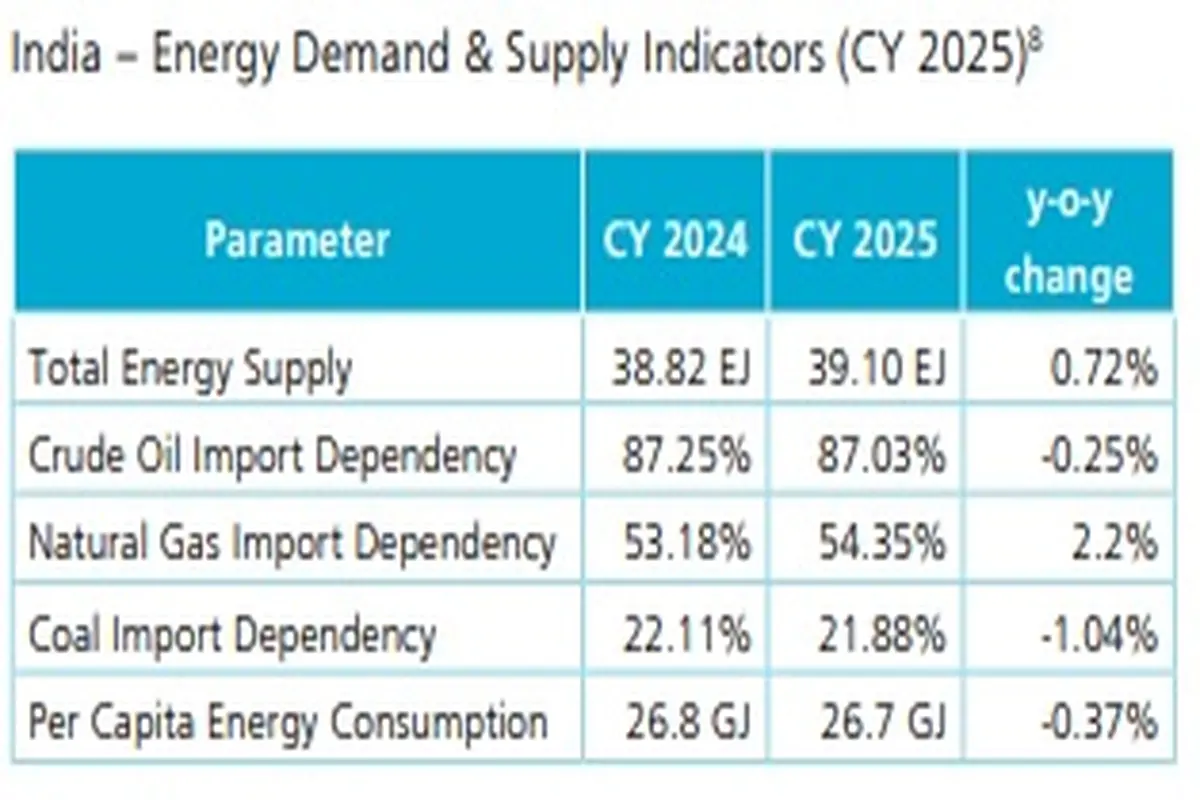
India's Energy Import Dependency — Structural Vulnerability
With high import dependency, India’s energy import profile also reflected a high concentration of supply from the Gulf region, creating a strategic exposure:
• Crude Oil: ~46% of total imports originated from Hormuz-exposed suppliers (Iraq, Saudi Arabia, UAE, Kuwait, Oman, Qatar).
• LNG: ~52.5% of imports were sourced from Hormuz exposed suppliers, with Qatar (40.4%) and UAE (12.1%) as dominant players.
• LPG: ~94% of LPG imports originated from Gulf/Middle East sources, making it the most vulnerable commodity in the imported energy basket.
Impact of Hormuz Blockade on India -Crude Oil, Products, LPG & Natural Gas
The escalation of tensions in the Strait of Hormuz from late February 2026 had a significant impact on India's hydrocarbon supply chain, as ~52.5% of India's LNG imports were sourced from Qatar and the UAE. Also, ~46.3% of crude oil imports originate from Gulf producers exposed to the Strait. While physical supplies of crude oil remained largely uninterrupted due to diversified sourcing and India's 256.1 MMTPA refining capacity, the disruption triggered sharp price volatility, with Brent crude rising to about US$ 117.5/bbl in March 2026, increasing import costs and pressuring refining margins. However, there was a significant reduction of about 25 % of LNG imports.
The impact was particularly severe in the LPG segment, where India depends on the Middle East for nearly 94% of imports. Supply disruptions and logistics constraints pushed Propane CP prices to US$ 545/MT in March 2026. In response, the Government invoked the Essential Commodities Act to prioritise LPG production by directing domestic refineries and petrochemical units to divert propane and butane streams to Oil Marketing Companies. To manage the disruption, the Government introduced a priority-based gas allocation framework for PNG, CNG, LPG production and fertilizer sectors, while GAIL was designated as the nodal agency for gas pooling. Additional measures included streamlining pipeline approvals, promoting PNG penetration and extending the CBG-CGD Synchronisation Scheme till 2047. Further, the CBG Blending Obligation (CBO) envisages phased blending of CBG in CGD networks up to 5% by FY 2028-29 supporting long-term energy security and reducing import dependence.
India Gas Sector Developments
India's natural gas sector continued to evolve as a key pillar of the Country's energy transition strategy during FY 2025- 26, supported by policy reforms, infrastructure expansion and increasing adoption across end-use sectors. However, global gas price volatility and geopolitical developments, particularly the disruption in the Strait of Hormuz during early 2026, posed challenges to demand growth in price-sensitive segments.
Demand Trends and Sectoral Consumption
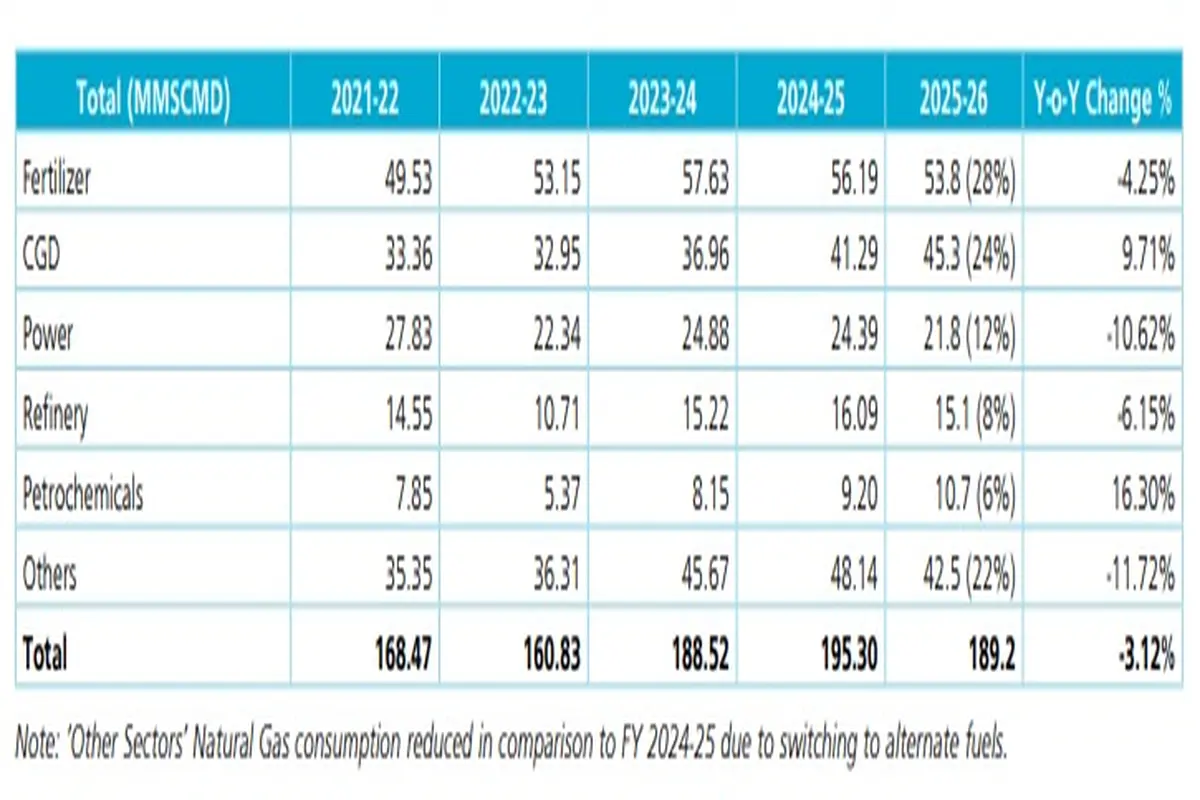
India's natural gas consumption stood at ~189.2 MMSCMD during FY 2025-26. The fertilizer sector remained the largest consumer, accounting for 53.8 MMSCMD (28%), followed by City Gas Distribution (CGD) at 45.3 MMSCMD (24%), power at 21.8 MMSCMD (12%), refineries at 15.1 MMSCMD (8%) and petrochemicals at 10.7 MMSCMD (6%). CGD consumption recorded strong growth of about 9.7% year-on-year, driven by expansion of PNG and CNG networks across the Country. In contrast, consumption in power, industrial and other fuel-switching sectors moderated during the year owing to elevated gas prices.
Domestic Production and LNG Imports
India's domestic natural gas production improved during the year, supported by output from offshore and deepwater fields, reaching ~34.3 BCM. However, LNG continued to play a critical role in meeting the Country's energy requirements, with LNG imports estimated at around 26.5 MMT. Consequently, import dependence remained significant at about 50.6% of total gas consumption, underlining the importance of supply diversification and energy security.
Infrastructure Expansion and Policy Developments
The Government continued to advance its vision of a gas-based economy through policy reforms and infrastructure expansion. A major milestone during FY 2025-26 was the implementation of the Unified Tariff regime under a two-zone structure, aimed at improving affordability and enhancing access to natural gas for consumers located farther from gas sources. The national gas grid expanded to ~27,427 km, supported by measures to streamline Right of Use (RoU) approvals and accelerate pipeline development. Simultaneously, CGD networks continued to expand across the Country, driving growth in PNG and CNG consumption.
The Government also maintained a strong focus on alternative gaseous fuels. The scheme for Development of Pipeline Infrastructure (DPI) for facilitation of Compressed Biogas (CBG) Offtake and the CBG-CGD Synchronization Scheme contribute towards the development of the CBG ecosystem with an aim to cut import dependence. Urban PNG expansion (replacing LPG) and ongoing pricing reforms further stabilize base demand. In addition, the CBG Blending Obligation (CBO) framework envisages phased blending of CBG in CGD networks up to 5% by FY 2028-29, supporting domestic production, reducing import dependence and advancing decarbonisation objectives.
Indian Petrochemical Sector— Impact of War & Feedstock Dynamics
India's petrochemical sector continued to benefit from strong economic growth, rising manufacturing activity and increasing domestic consumption. The market size of the Indian Chemicals and Petrochemicals sector is expected to grow to approximately USD 300 billion by 2028, up from its current market size of USD 220 billion & all analyst are quite bullish on the growth trajectory of India for next two decades. With per capita polymer consumption of about 14 kg, compared to the global average of 42 kg, India remains one of the most attractive long-term growth markets for petrochemicals and is expected to account for a significant share of incremental global demand.
During FY 2025-26, the sector faced volatility in feedstock and energy markets following the Middle East conflict. Higher crude oil prices increased the cost of key feedstocks such as Naphtha and LPG, putting pressure on petrochemical margins. As nearly 80% of India's petrochemical capacity is refinery integrated, the rise in crude prices translated into higher domestic feedstock costs and impacted cracker economics across the industry.
The disruption also highlighted the importance of feedstock diversification and supply security. Government measures prioritising propane and butane for LPG production, coupled with constraints in domestic gas availability, affected gasbased petrochemical operations, including facilities dependent on domestic ethane. Overall, the developments underscored the need for diversified feedstock sourcing, integrated operations and resilient supply chains to maintain long-term competitiveness.
The above report has been extraced from GAIL India Limited's Annual Report for FY 25-26

6 days ago
Total Views : 24
6 days ago
Total Views : 15

6 days ago
Total Views : 13
3 weeks ago
Total Views : 28