Loading... Today

-- 0

-- 0
The Print Times
Industry Structure and Developments
The global footwear market, valued over USD 484 billion, is projected to grow at a CAGR of ~7% by 2032, on account of rising demand for sports and athleisure footwear, with growing number of individuals wearing different footwear for different occasions. In addition, there is a rise in demand for fashionable footwear that helps in reflecting the individuality of a customer.
The global footwear market is segmented into men, women and kids. Increasing fashion consciousness among male customers and rising participation in sports activity, triggers men’s footwear sales. The women segment holds the second largest market share, driven by the increase in women workforce across countries.
India continues to be the world’s second-largest producer and consumer of footwear. The leather industry of India is also a significant contributor to the global supply chains. India’s footwear market is driven by various factors like income level, purchasing power, aspiration for branded products, gender ratio, organised retail, digital adoption, penetration of mobile phones, etc. Increasing disposable incomes are aiding customers to prefer better quality and branded footwear, while rapid development and changing lifestyles are pushing the demand for fashionable and diverse footwear. Increasing awareness of health & fitness is also boosting athletic and sports footwear sales in India.
Driven by strong consumer demand and largely untapped middle-class population, the Retail Industry in India is estimated to cross USD 1,600 billion by 2030. Branded goods across categories such as apparel, cosmetics, footwear, watches and jewellery are increasingly becoming part of everyday lifestyle. Technology innovations, global partnerships and strategic investments are further reshaping the retail landscape.
The sector’s growth is further reinforced by expanding retail infrastructure. According to an estimate, India’s seven largest cities are expected to add over 16 million sq. ft. of new shopping mall space by the end of 2026.
However, the Indian retail sector continues to resolve supply chain limitations, outdated technology, real estate challenges and sluggish discretionary spending.
India’s e-commerce is projected to reach ~USD 550 billion by 2035, supported by changing consumer mindset, rising internet penetration and growing trust in digital transactions. While the connectivity Annual Report 2025-26 | 29 space is improving, the regulatory e-commerce policies will eventually shape the growth strategies for the sector, with significant boost in footwear sales.
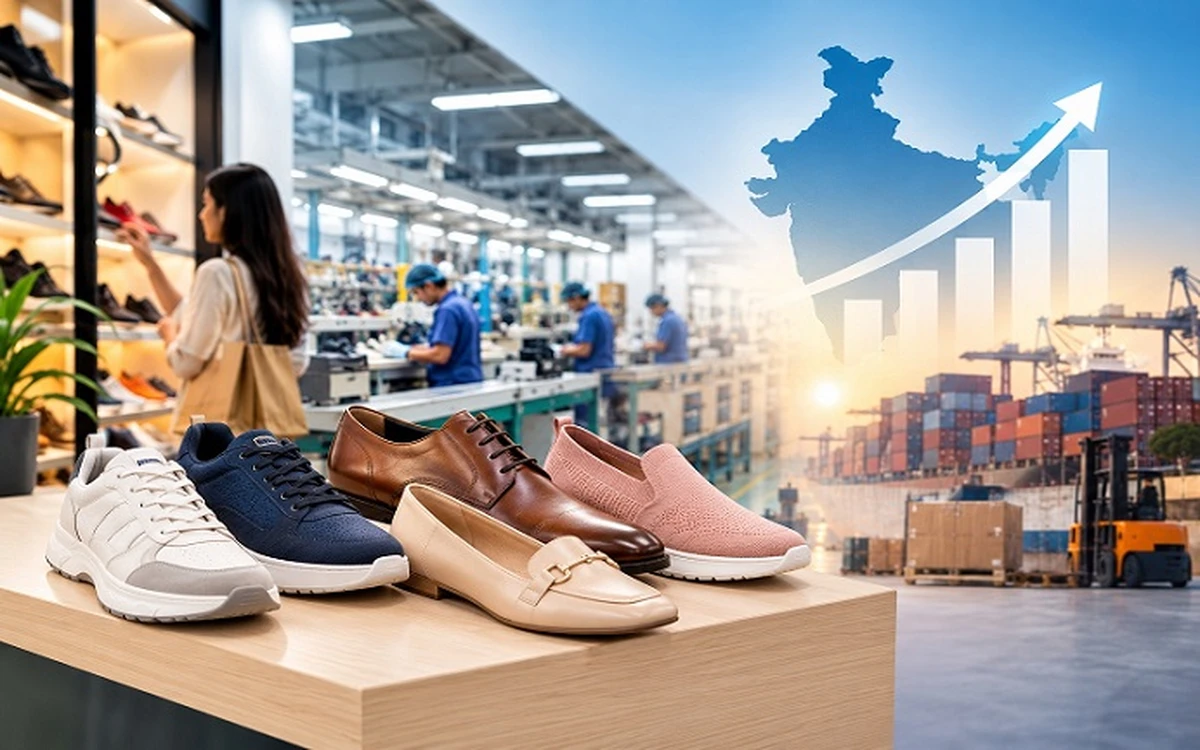
India’s footwear sector is undergoing a transition in the customer perception. From a pure utility product, footwear is now an expression of identity. Once a very large informal sector, the Indian footwear market has seen substantial organisation in recent years. The sector is shifting towards branded players and increasing digital penetration. However, the average per capita footwear consumption in India is still well below 2 pairs per annum as against the global average of ~3 pairs per annum.
The Indian footwear market is projected to cross USD 90 billion by 2030, on the back of factors like:
a) Consistent rise in income and purchasing power.
b) Aspiration for branded products.
c) Increase in non-occasion wear purchases.
d) Continuous increase in working population ratio. e) Increase in digital payments and online shopping.
However, macroeconomic factors like inflation, unemployment rate, distribution of income, social constraints, etc., may regulate discretionary spending. High real estate costs and supply chain limitations are other key constraints for footwear retailers.
Outlook
The Indian footwear industry is an essential part of the economy. Over the years, the Indian footwear market has evolved with changes in fashion, technology and consumer preferences, making it one of the largest footwear markets globally. Additionally, India’s population is expected to reach ~1.5 billion by 2030, further boosting demand for footwear. Additionally, changing preferences among millennials and Gen Z, such as focus on casual, comfortable and fashionable footwear, have opened up new opportunities in the industry. However, the population owning multiple pairs of shoes still remains low.
India’s retail sector is at a crucial juncture as brick and-mortar stores and e-commerce channel (including quick commerce) are competing for market share. Further, the consumption landscape in India is experiencing a prolonged slowdown in discretionary spending. Inflation trends, income stability and employment conditions will continue to shape discretionary spending.
The implementation of GST 2.0 has stimulated a consumption boom, however, the same has moderated over time. Despite this, India’s retail sector has entered 2026 on a firmer footing than it did a year ago. Retail sales growth indicate renewed consumer confidence, particularly in discretionary consumption. However, this growth is shaped by value awareness, selective spending and intensifying competition.
With an aim to reach a USD 50 billion leather and footwear turnover by 2030, the Government of India has launched the Indian Footwear and Leather Development Programme. The effective implementation of this programme is likely to provide stimulus to the sector.
The above report has been extracted from Bata India Limited’s annual report for FY 25-26